2026-06-26 13:57:50
A 3D Wooden Puzzle works by using a collection of precisely laser-cut wooden pieces that interlock to form a three-dimensional model without requiring complicated tools.Each piece is designed with tabs,slots,or joints that fit together in a specific sequence,allowing the puzzle to transform from flat wooden sheets into a realistic structure,such as a building,vehicle,animal,or mechanical model.
Unlike traditional flat jigsaw puzzles,a 3D Wooden Puzzle challenges both spatial reasoning and hands-on assembly skills,making it an educational and entertaining activity for children and adults alike.
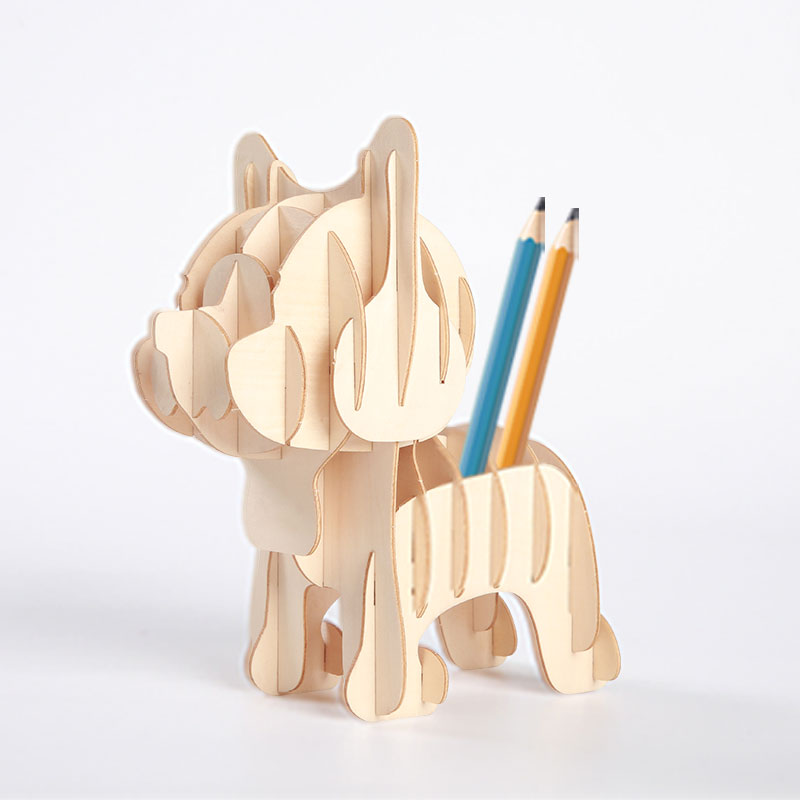
The working principle of a 3d wooden puzzle is based on precision engineering and interlocking construction.Every component is manufactured with tight tolerances so that the pieces connect securely without nails or screws.
The process generally follows these steps:
Manufacturers use laser-cutting technology to cut puzzle pieces from plywood or basswood sheets.This process ensures:
Smooth edges
Accurate dimensions
Easy removal from the wooden board
Perfect fitting connections
Each piece is numbered or labeled to match the assembly instructions.
Instead of glue or fasteners,most 3D wooden puzzles rely on an interlocking system.
Common connection methods include:
Slot-and-tab joints
Mortise-and-tenon structures
Snap-fit connectors
Locking grooves
These joints distribute force evenly throughout the model,making it surprisingly sturdy after assembly.
Builders follow an instruction manual that guides them through assembling the puzzle in a logical order.
The process usually starts with:
Base frame
Internal supports
Exterior panels
Decorative details
Moving components(if included)
As more pieces are added,the structure gradually becomes stronger and more stable.
Many models include hidden internal frames that provide strength.
These internal components:
Maintain alignment
Prevent deformation
Support heavier decorative parts
Improve durability
This engineering principle is similar to how real buildings and vehicles use internal frameworks for stability.
Some advanced wooden puzzles are more than decorative models—they include functional mechanical systems.
These may incorporate:
Interlocking wooden gears transfer rotational motion from one component to another.
Applications include:
Ferris wheels
Clocks
Music boxes
Vehicles
Some mechanical models use wound rubber bands to store energy.
When released,the stored energy powers:
Cars
Airplanes
Tanks
Tractors
This demonstrates the conversion of elastic potential energy into kinetic energy.
A rotating cam changes circular motion into back-and-forth movement.
Examples include:
Walking animals
Moving wings
Dancing figures
Turning a crank transfers motion through rods and gears to animate different parts of the model.
Most 3D wooden puzzles are made from environmentally friendly materials.
Common choices include:
Basswood
Birch plywood
Poplar plywood
MDF(Medium Density Fiberboard)
High-quality wood offers:
Smooth surfaces
Strong joints
Minimal splintering
Long-lasting durability
The success of a 3D wooden puzzle depends on manufacturing accuracy.
Modern laser-cutting machines achieve tolerances of less than 0.2 mm,ensuring:
Tight joints
Easy assembly
Reduced wobbling
Stable finished models
Slight friction between the tabs and slots helps keep the structure firmly together.
Building a 3D wooden puzzle develops many practical skills.
Users must determine how each piece contributes to the final structure.
Assemblers learn to visualize three-dimensional shapes from flat components.
Small pieces improve hand-eye coordination and finger dexterity.
Complex models may require several hours or even days to complete.
Mechanical puzzles introduce concepts such as:
Gear ratios
Structural engineering
Motion transmission
Mechanical advantage
Energy storage
There are many different styles available.
These recreate famous landmarks,castles,bridges,and historical buildings.
Popular models include:
Cars
Trains
Ships
Airplanes
Motorcycles
Examples include:
Dinosaurs
Birds
Horses
Wolves
Dragons
Designed with moving parts,these often include gears,springs,and rubber-band-powered mechanisms.
These are intended primarily for display after assembly.
Some of the biggest benefits include:
No batteries required
Eco-friendly materials
Reusable and durable
Educational value
Attractive home decoration
Suitable for all ages
Encourages creativity and logical thinking
Many premium models can also be painted or customized after assembly.
3D wooden puzzles are widely used for:
Educational STEM activities
Family entertainment
Classroom projects
Hobby collections
Gift items
Interior decoration
Cognitive training for seniors
To achieve the best results:
Read the instructions before starting.
Remove pieces carefully to avoid breaking small tabs.
Assemble on a flat,clean surface.
Organize parts by number.
Sand tight joints lightly if necessary.
Apply wood glue only if permanent assembly is desired.
Take your time with complex mechanical sections.
Most models are designed to fit together without glue.However,glue can be used if you want a permanent display model.
Difficulty varies by model.Beginner puzzles may contain fewer than 50 pieces,while advanced mechanical models can include more than 500 pieces and require several hours or days to complete.
Yes.Many puzzles are designed specifically for children,while more complex models are recommended for teenagers and adults due to the number of pieces and intricate assembly.
Yes.Many feature working gears,rubber-band-powered motors,rotating wheels,moving arms,or opening doors,demonstrating basic mechanical engineering principles.
Laser cutting provides extremely precise pieces with clean edges,ensuring a snug fit,easier assembly,and a more durable finished model compared with traditionally cut wooden puzzles.

Room 201, Building 1, No. 1, Brick Kiln 2 Heng Road, Dongcheng Street, Dongguan City, Guangdong Province, China


Copyright © 2026 Dongguan XinYue Arts & Crafts Co., Ltd. All rights reserved.
Privacy Policy Cookie Policy Terms and Conditions



 English